Evolution of interactions
From antagonism to cooperation and beyond
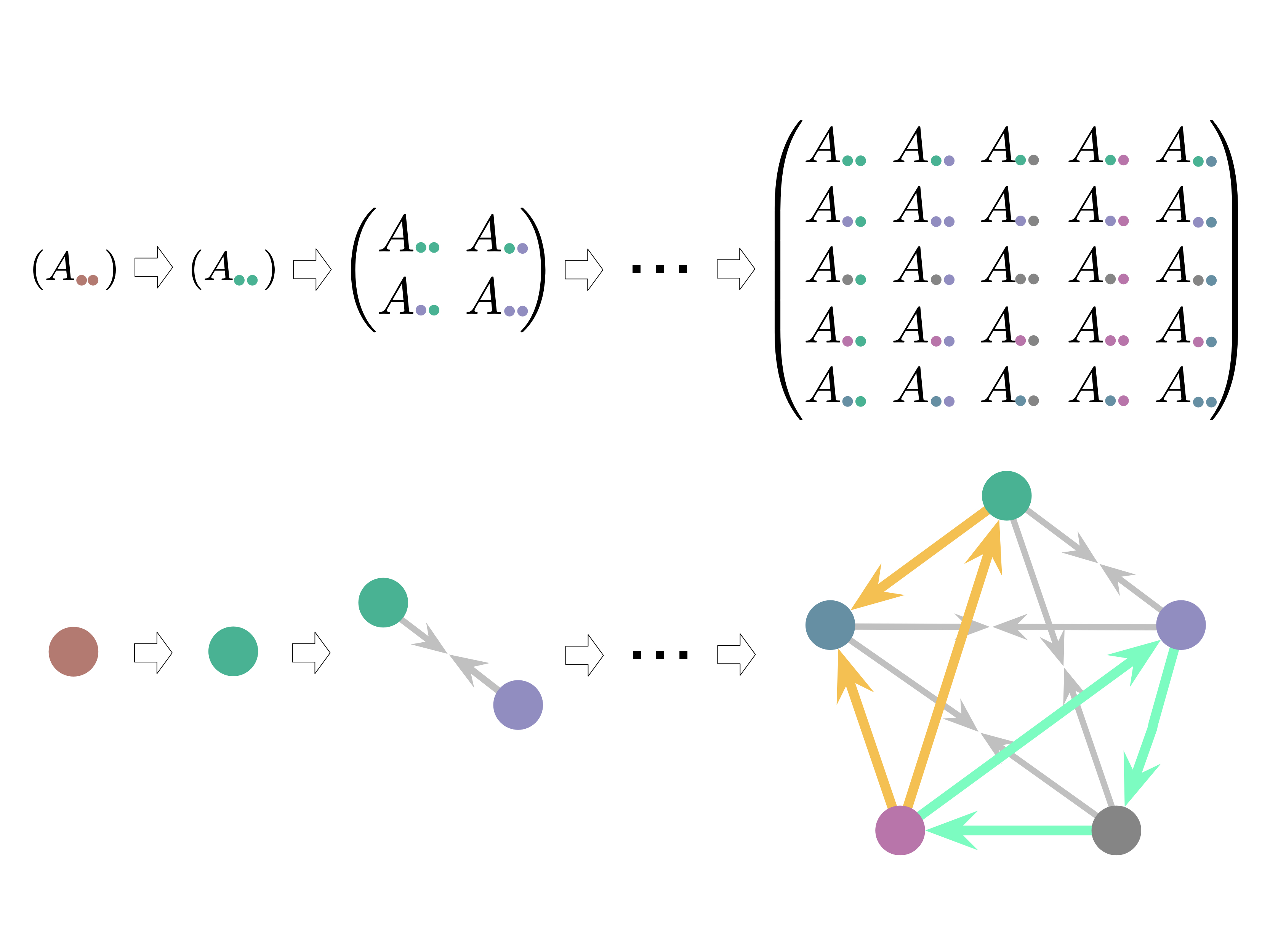
In evolutionary game theory, the fitness of the individual is determined by a payoff from a game with other members of the population. The mutant game starts with a population made of a single species (and hence a 1-by-1 payoff matrix). New species are allowed to emerge as a result of mutation. At each such event, the payoff matrix gets extended with new payoff elements derived from corresponding matrix elements describing the interactions of the parent species. Whenever a species goes extinct, the matrix shrink, as the corresponding elements get discarded. The mutant game creates an open-ended dynamical population, in which not only the population composition but also the rules of interaction between its members are subjected to natural selection.
Papers
How open-ended evolution of interactions shapes population fate: Population size changes and extinction risk of populations driven by mutant interactors. Park, H.-J., Pichugin, Y., Huang, W., and Traulsen, A. Phys. Rev. E, 2019. (link)
What makes some configurations of interactions more common than others: Why is cyclic dominance so rare? Park, H.-J., Pichugin, Y., and Traulsen, A. eLife, 2020. (link)
What multicellular populations can evolve, if cell groups interact with each other: Eco-evolutionary dynamics of clonal multicellular life cycles. Ress, V., Traulsen, A., and Pichugin, Y., eLife, 2022 (link)